CrossFitBurbank.com HERE
(626) 863-0008                                (818) 939-1188

824 HollywoodWay, Burbank 91505
Map HERE

WodWorks HERE
fw@FitWorksTraining.com
___________________________________________________________________

Showing posts with label physiology. Show all posts

How Things Work

 It's so interesting,  how the brain works, or the mind-body connection, or the CNS-PNS,  central-peripheral .  Afferent and efferent nerves -- the same as sensory and motor nerves. Only two sorts of neurons, inward and outward, to the brain or away. Inward is sensory, information about everything other than the brain, whether within the body or from the great wide world. Outward is motor, to get things done, either muscles or organs, somatic or autonomic. Neuron axons bundled in the peripheral nervous system are nerves; axon bundles in the CNS are called tracts. 

The brain communicates with the body in only two ways -- through motor nerves or through hormones. Nerves are a direct line, like telegraphs. Hormones float through the bloodstream hoping to be picked up by cell receptors -- something like fish and nets.  Why does exercise make muscles grow? An exercised fiber becomes more receptive to hormones. Hormones are released when enough fibers are exercise. So it's central nervous system, and it's endocrinal. 

And the way the CNS develops -- the brain and spinal cord. It starts as a sort of looped tube, eventually with six parts, spinal cord and the five parts of the brain. A tube.  It's not an addition thing, this development, not one part of the brain developing, then another one, more advanced, then yet another, and so on.  It's all there, inherent in the beginning.  It all happens all at once, with all vertebrates, the way you'd blow up a plastic bag. There is no fish brain and lizard brain and mammal brain. There are just bigger and smaller parts of the brain, depending on class. A fish's cerebrum is smaller than its eyeball. A rat's cerebrum is the size of its ear. Humans' fill up everything behind the eyes and up. But it's all the same basic plastic bag -- just different shapes.

That's the body, and the brain. Not quite the same as mind, or soul. Think of it as music. Flute music. What makes it? The breath of the player? The shape of the instrument?  Both, but not only both. Music is not breath and flute -- that might very well be just noise. We are made by genetics and shaped by experience -- but we are not breath through a flute, not experience acting through genes. We are music, inspiring as well as respiring.


FW

Your Colon & YOU!!

It's hard know how to begin. The subject is rather delicate. Sort of a private thing. Almost taboo. No, actually taboo. But that doesn't mean it should be ignored. The usual Youtube field just won't do. No, you can copy and paste the links. That way it's entirely on you. The management and stockholders of the FitWorks Corporation, International can take no responsibility for any potential untoward emotional or aesthetic consequences.  On the other hand, never mind ... cut and paste is too much hassle.

So HERE is a colonoscopy vid, of various patients.  Some healthy, some pathological. It doesn't seem to be impacted fecal matter, "like spackle or paste" to quote a common radio commercial, but it's slimed on there in a manner and to a degree that is clearly desperately unhealthy. Diet diet diet.

The woman at 3:35 pretty much clinches the case: the colon is highly correlated to overall health. Did that incredible mess of a bowel cause her cancer? That would be overextending the evidence. But it's obvious that her colon is utterly toxic. The product ads for fibers and herbs and cleansers and hoses have a marketing agenda. The research seems not to have been done, regarding toxins absorbed to cause disease. But a sick colon is symptomatic of a sick diet, which is, frankly, the cause of virtually every lifestyle disease. It's shortsighted to address the symptom, be it either colon or cancer, without addressing the cause -- diet.

On the other hand, the colon of someone with a healthful diet is a veritable garden of delights. That's an article of faith, for most people, but it must be so. A high percentage of plant-based foods is colo-riffic! Animal cells, you see, have a membrane, whereas plant cells have a wall. The membrane is just fat, and dissolves when digested into something like, well, lard, providing no roughage, as grandma used to called it -- nothing for peristaltic motion to act effectively upon; the wall is cellulose, undigestible, and gives rocket power to all your elimination needs! It's the difference between scrubbing on the one hand, and on the other constantly slathering the lumen with fetid slime.

Something is indeed going on, with the large intestine. Take this guy for instance: just a little freaky, wanting to share what he shares, but illustrative.

Hey, you were warned.

A mass of algae-looking mucus in his toiletbowl after a six day fast. But, if it's true, we really should know about it, in a general sense. It's just the specifics that are sickening. So you just hurry out right now and buy some fiber, eh? Please? And drink water, like a lot.

As for worms, unless it's some sort of CGI effect, behold.  And behold again.

Now, hospitality is a very fine thing. Good old-fashioned values. And didn't St Francis teach us to be kind to animals? But this is going a bit too far past the extra mile. No matter how moonbeam someone might be, loving the earth and being kind to all the growing things and all that hippie stuff, uh, KILL THEM!!!

Upshot: John Wayne did not have 20 pounds of impacted fecal matter in his colon. Well, maybe he did, but we don't know about it. No autopsy. Lies lies lies. Elvis on the other hand did have a desperately sick colon: fully half of it was "jam-packed" with dried chalky feces. The drugs did that, and his bloat-making diet. So we know crud gets stuck, in a more than constipational way. There are autopsy colons of incredible size and weight. These are pathological, of course, and turning on an internal firehose might have done some good, but so would surgery. Neither would be a cure, for a poisonous lifestyle. But the first would certainly be an easy way to buy some time -- like draining a boil. Doesn't really matter if a boil is poisoning the body -- it just needs to go.

As for those hideous colonoscopy vids, this is what we've suspected all along. It's not brittle, not dry, this fecal mucous or mucosal feces. But it is stuck. Like cheese, then. You are just chock-o-block full of cheese. And algae. And worms. Why do you do this to yourself. So sad.

Well, a certain silliness of tone is not entirely amiss. It's an uncomfortable topic. Colons. Yick. But we are made out of what we eat. How is this relevant to fitness? Well, duh. FitWorks has a primary focus on increasing health and functionality through exercise, which is, after all, far more manageable and rational than diet. But you are made out of food, and diet is at least as important as exercise. Look at it this way: a city is only as healthy as its sewers.  If you've ever used a Tijuana outhouse, you know it's true.

Be excellent.

Here: CrossFitBurbank.com


FW
CrossFit Burbank

Stretching

Stretching isn’t about being able to do splits. It’s about avoiding chronic and/or acute pain.

 Skeletal muscles can do only one thing -- contract. Well, relax too, but that’s just part of the one thing. Every muscle attaches at each end to a different bone, across a joint. A muscle cell, a fiber, sort of reels one end of itself in toward the other, the opposite of a rubberband -- it’s a sort of hand over hand tug-of-war process, as if two caterpillars met head to head and then walked along each other’s belly. Confusing, eh? Point is, the ends get closer together.

 We get stiff, inflexible, muscle bound, stooped, when muscles reset themselves into a contracted position, so that too-short becomes the new norm. Spend 8 hours working at a desk, or 12 hours watching a Twilight Zone marathon, or 16 hours playing, um, Tetris, and you’re teaching your hamstrings that short is the healthy way to be. When we try to pull them out again into a longer, healthier full-range position -- what we’d call stretched but which is really just relaxed--this is perceived as an abnormal stress on a joint, perhaps even dangerous. Joints are higher than muscles on your brain’s list of things to protect, so there is automatic resistance to any stretch beyond the habitual. And what you do for 8 hours straight, your body considers the norm.

That’s the stiffness -- a signal from your muscles to you that you’re getting dangerously ambitious, what with your bending over to tie your shoe like that. How dare you disrespect your body so flagrantly. Back off, sweet child, you’re flying too close to the sun. Stiffness. The reaction may be violent, in fact, if the danger seems grave, and the muscle reacts like a finger flinching from fire -- spasms, pulls, tears. Better a torn muscle than a damaged joint. Problem is, there was no danger. You just haven’t been doing your stretching, your relaxing. Your body is a domesticated animal: you may think it’s a fierce boar, but it’s a pig … that may be an unflattering analogy. You think it’s a wolf but it’s a dog, and it learns what you train it to do. Teach muscles to stay contracted, hour after hour, and they will obey, and enforce the lesson with stiffness. Or with rips. Or with atrophying rigidity.

 So. Functionality functions most functionally when fully elastic muscles operate joints that are properly aligned. Your body is in its groove. Lots of body parts can slip out of their groove. Slumped shoulders, drooping head and neck, pelvis tilted forward or back (which rounds or sways the lower back), knees and feet pointed out or in (duckfeet or pigeon toes).

 These are all significant problems, which may never actually cause pain for some lucky folks, but will always increase the risk of injury. Consider: if a rubber band is already fully stretched, and then pulled even more ... injury. Whereas: if a muscle-tendon unit has sufficient and healthy range of motion, a fall or blow need not over-stress it -- there’s enough give and take to avert trauma. Thus: we want to preserve and recover healthy flexibility as a matter of prudence and responsibility. We don’t stretch so we can show off our splits; we stretch so we don’t have debilitating pain come out of nowhere and ruin our lives and destroy our optimism and transform us into bitter joyless recluses just waiting for the onerous burden of life to finally, at long and agonizing last, pass.

 Ideal skeletal structure is symmetrical to such a degree that it can only be called elegant. Like Leonardo designed it. Brilliant, actually. The shoulder joints, hips, knees and soles are all equidistant, one from the next. Proper posture has ankles, knees, hips and (depending on body-type) shoulders all precisely parallel.

 From such a pinnacle, it’s all downhill. Splayed feet, which turns walking into a sort of skating.
 Only a moment’s thought will demonstrate the problem, the inordinate and chronic stress on the ankles. We don’t want to skate. We want to ski. And observe the knees -- pointing outward, which is what splays the feet. And the knees are just revealing the displacement of the hips. An obvious issue then, but not a simple one.

Again, slouching shoulders.
 The shoulder blades aren’t doing their job. The resulting pain need not be restricted to the logical places, neck and back. Pain migrates.

 The most common cause of posture-induced pain is a downward tilted pelvis.
 If everything is thrown out of balance, forced to realign, sacrificing proper function for simple balance, then muscles will of necessity be forced to do work they can but were not designed to do. Prime-movers become postural, and visa versa. It’s madness.

 The upward tilting pelvis looks as degenerative as it is. You’re old before your time.

And so on.   Listing

 … yawing
 … just ready to capsize, keel over, break in two and sink to the crab-scuttled floors of silent seas.

These oddities of posture are the virtually universal norm. All those computer games have twisted our bones as well as our minds, and souls.   Repent! With maintenance stretching, your bones don’t have a choice but to fall into healthy alignment. It’s not bogus. It’s excellent.
Seems like a smart thing to do.

Be excellent.


FW
CrossFit Burbank

Wrong Theories


The Good Thing About Damage...

Gym coaches are still telling their students that the way muscles grow is that first muscles get torn down by exercise, damaged, and then they build up again, repair, only stronger. Yep. Damaging something makes it stronger. Like mutations and Evolution. Uh huh. Cuz that’s what the body does, y’see, when it gets big muscles. Something to do maybe with scar tissue.

No. It isn’t the damage that makes us stronger. The damage comes not from doing enough, or from being effective. Damage comes from doing too much, from overtraining, and from foolishness. Yes, it can accompany muscle growth, the way busted gaskets can accompany reckless driving. But jumbled in with all such associations is a profound tendency toward the post hoc logical fallacy. Correlation does not support causation. No duh.

The actual “cause” of muscle growth is hormones -- not movement, not exercise, not sets and reps and routines. None of these things could have any beneficial effect, without the hormonal signal to add protein to muscle cells -- whereas new size can be added if the hormones are there, with only a token amount of exercise. Effort stimulates hormones, but effort does not build muscle -- hormones do. Keeping it simple, of course. Steroids? The needle replaces the effort, so the same amount of work produces much bigger muscles. Smaller testicles though. An acceptable tradeoff, one must suppose.

The point is, how do we stimulate the clearest hormonal signal? Intensity. Major muscle mass engaged in powerful effort. The brain reads this as a call for more strength, and provides it. Damage? The brain reads this too, and sends out reparative hormones, to clean up the mess. The mess, however, does not make you stronger. It’s there because the workout was foolish. Coach was wrong.

So that’s one sort of wrong theory, arising from the wrong theory of isolation exercises, where doing bodybuilding, which is entirely about appearance, is supposed to make people more fit. Fit for what? In actuality, fit for standing on a stage in a thong, chemically bronzed, slathered with baby oil, glinting in the spotlight. Oooooh. The correct theory, we modestly asseverate, regarding how one might attain fitness, is that it is achieved by treating the whole body as a unit, rather than as a collection of mostly independent parts.

There's more to say of course, and perhaps it will be said. The future is such a hypothetical thing. What is certain is that under normal circumstances sensible exercise and sensible diet bring reasonable results. And who would want unreasonable results? Reasonable fitness goals, of energy and strength and weight and appearance, are not just honorable.  They're intrinsically rewarding. And personal excellence is a reasonable goal.

Be excellent.

Here: CrossFitBurbank.com


FW
CrossFit Burbank

A Very Boring List of Overtraining Symptoms

  • Morning pulse higher by five or more beats per minute
  • Abnormal rise in heart rate upon standing, or pre- or post-workout
  • Slower heartrate recovery after workout
  • Poor posture, slouching
  • Loss of drive or joy; apathy
  • Lethargy, listlessness, boredom
  • Desire to quit during competition
  • Peevishness; anxious; easily irritated
  • Unable to relax
  • Inability to concentrate
  • Changes in sleeping patterns; insomnia
  • Unrefreshing sleep
  • Loss of appetite / libido
  • Poor coordination, clumsiness
  • Increased thirst
  • Dejected, drawn look, sallow, gaunt
  • Prolonged sluggishness, heavy-legs
  • Undesired weightloss
  • Muscle or joint pain
  • Persistent and increasing soreness
  • Slow healing of minor scratches
  • Lymph node swelling
  • Gastrointestinal disturbances, diarrhea
  • Increased headache, infection, allergies, injury
  • Loss of menstruation
  • Increased blood eosinophin count;
  • Serial T-wave changes on the electrocardiogram
  • Mild hypothalamic, sympathetic and adrenocortical insufficiency

Yes.  Very boring.  BOOOORRRRRIIIIIINNNNGGGGG.  So, uh, let's just ignore it?  Because it is insufficiently amusing?  Our ennui shall keep us safe?  This "responsibility" thing is so tiresome.  Worse than a wod, if such a thing is possible.  We will train unceasingly and progress infinitely beyond mere excellence.  For are we not superhuman?  Of course we are.  Yes.  Yes.  Ahhhhh.

No.  Be responsible.  Be merely excellent.

Here: CrossFitBurbank.com


FW
CrossFitBurbank

Wrong Theories, pt. II


Climbing Higher than Possible

Another wrong theory. The plateau. The dreaded plateau, where you work and work and just don’t make any more progress. How very sad for you. Your body has adapted to some motion, some exercise, and you’re stuck, just can’t break through to a heavier weight, or continued fat-loss. So frustrating. How to fix it? Do more of the same? Try harder? Psych yourself up? Pray? Take a supplement? Have your spotter do more work, all the while saying that it’s “All you!”

Some of it, this limit, is psychological. The 200 benchpress, or 250, or 300. It’s not the weight, it’s the number. Frightening, somehow, and the unconscious mind just won’t let you do it. But that’s not what we’re talking about. We’re talking about the actual limit to what your body can do with that motion. It’s a real barrier. Lots of theories, not all of which can be correct. How bothersome, all these wrong ideas filling people’s heads. Like the way to overcome the plateau limit.

“Muscle confusion”. Goodness. What a ridiculous concept. It’s just a descriptive term though, and of course there is no brain in the muscles to be confused. Still, it’s a silly phrase. Adaptation is a smarter one. The body has become efficient at executing a movement, say the benchpress, and it’s become more of a skill than a stimulus to muscle growth. This is a bad thing? Only if it’s size, and not effectiveness, that you’re after. Well, either size, or attaining a new goal -- the latter of which is an honorable thing. Even so, for all that adaptation may be an explanation, it’s not a solution to the problem.

We humbly propose another solution to the problem. It’s not that the muscles, the pecs and the triceps, have become as strong as they can be. Far from it. These muscles are not the limiting factor. The limit, the plateau, is in the so-called stabilizing muscles. These neglected "muscles" are not being challenged by that same old foolish motion, executed rep after rep, set after set, day after week after years and years and years. Mercy. Is there nothing else to do with your time, than these same few non-functional movements, mindlessly rehearsed like a pagan bowing before his idol?

It’s not a plateau, it’s a rut. It’s not the big muscles -- they’re getting plenty of work. It’s the auxiliary muscles, the stabilizers -- the unrecruited motor units; they're not getting much of a workout, not even in their supporting role. The big muscles have crowded the auxiliaries out, attempting as it were to take over their function. The trained motor units have reached their capacity, and can't grow any more disproportionately. Well? The benchpress may think it’s a lonewolf hero, but it’s just a player on a team. Everyone needs to play, on a team.

The way out of the rut is indeed to mix things up, do new movements -- give the rest of the body a chance to develop. It should be obvious. It’s only one of the many reasons that constantly varied functional movements must be the core of an effective training program. It’s not an eat-your-vegetables sort of thing, because eating them is somehow theoretically good for you. It’s because vegetables supply the most nutrients; in this same way, doing many varied movements trains the whole body, including the limiting factors, the weakest links, the stabilizers, a full range of motor units within a given muscle. This is what makes the difference between someone who only looks big and strong, and someone who is actually strong, no matter how big.

There's a lot of nonsense in the world. The relative proportion between foolish and wise is probably about the same when it comes to fitness. Perhaps more. Perhaps much more. No matter. We don't know what we don't know we don't know, if we think we know it. Sometimes however we get the chance to correct a wrong notion, or a wrong practice. This is a wonderful thing. We do, after all, live inside our bodies. That's a world where nonsense can make you weak, or unattractive, or old before your time or ill, or worse.

None of us can undo all of the nonsense, because hardly anything is perfect, and of that catagory, none of us fit. No tragedy. The tragedy is not that we aren't perfect, but that excellence is possible, while so much less is the norm. If you'd like to undo some of the decay, you can start with yourself. 

Be excellent.

Here: CrossFitBurbank.com

FW
CrossFit Burbank

Tonic

It is required that one use a little common sense. Not even a lot. Just some. Like, you actually believed that alcohol was good for you? Because the news told you about a study? O, Despair! For reals? Your mommy told you there was a Santa. Your teacher told you there was protoplasm. Can't we just please do a little thinking for ourselves? Yes. Sure. Drinking poison, a toxin, is going to do wonders for you. It's so good for your heart. Mmm. That red wine is a miracle drug! Salut!

Or you could use your brain. Oh, it reduces cardiovascular disease in women? -- raises good cholesterol and moderates bloodsugar? That is so great! And it lowers prudish inhibitions! So that's a win-win situation! And a daily glass of wine is linked to reduced dementia, boneloss, and lymphoma. That too must somehow be good for the love life. Demented, boneless, lymphomatics -- they just don't do it for the happenin' playah.

But drinking any alcohol at all -- let alone "moderate" -- increases risk of getting cancers of the breast, liver, mouth, pharynx, larynx, esophagus, colon and rectum. The cardio benefits of wine are precisely matched by the increased risk of stroke -- it's good for the heart and bad for the brain. Drinking any amount over moderate, one glass daily for women, two for men, is powerfully linked to a plethora of problems. Disturbed sleep, impaired judgment, and slowed reflex reactions. Fetuses. For younger men, the risks of accident with even moderate drinking far outweigh the cardiovascular benefit.

Health benefits? They come largely from the antioxidants and anti-inflammatories that red wine and dark beers have, independent of alcohol content. Grape juice does the same thing. Or fruits and vegetables, and they don't deplete your B vitamins.  Yes, it decreases social inhibitions, and not all inhibitions are bad, as not all are good.  So there's that.  On the other hand, one's real, inner playah might show through, whatever that is, and it may be vicious.

The convivial lubricant and gaiety-maker has an  inverse correlation to the quality of the conversation. To those who are enjoying their moderate drink, their comments may seem profound or at least insightful. Conversely, they may seem even more obvious than usual. There is much to be commended in emotional availability and an unguarded tongue. But the same could be said for any of the other recreational mood/mind alterers. When we are sick, we need drugs. Give strong drink to the dying. Alas, the judgment it would take to make the judgment call is impaired by the cure.

The ethanol molecule interacts with human biology in untold ways. Of course there are benefits. But the cardio benefits that moderate drinking provides would not be needed at all, were it not for an toxic diet. To use one poison to mitigate against another poison is standard medical practice. Prevention at the level of root cause is not standard practice. So, sure, if one eats foolishly, drink wisely. There is a wisdom of sorts in this. But it's an ironic one.

Maturity seeks out simplicity, and an apt philosophy in this regard is, be happy. This requires that we be good, in the philosophical sense.  The mild tonic effect that alcohol can have is not toxic. The body can handle small doses of poison. If you know your particular genome down to the final allele, then you can do no wrong, or if you do, it is a considered choice. But ... you don't know your genetics. Live in fear? Feel deprived? No. Be happy. Be happy if you have a stroke, though, or get cancer of the rectum.

Be excellent.

Here: CrossFitBurbank.com


FW
CrossFit Burbank

Cravings

Cutting down animal products in the diet is a generally wise choice. There are very clear problems correlated with a lot of meat in the diet, whereas there are no common problems with a sensible variety of plant-based foods. It's not about being vegetarian -- it's about meeting the nutritional needs of a human body -- which are met in large part by vegetables, fruits and so on. Moderation, of course.

The more interested someone becomes in the elite functioning of their bodies, the greater the attention they will pay to their diet. Garbage in, garbage out. Most people notice a benefit in cutting back on the meat. Nothing to argue about here. If you don't, that's fine. Most do. But some folks feel hungry and tired when they start to cut back on meat. Why would that be, if they're getting all the nutrition they need? And why the craving?

Let's take a little detour. A useful definition of hunger is not "the feeling of an empty stomach," but rather "the body's craving for nutrients." Big difference. We crave what our body actually needs, that will make it stronger and healthier.

Let's take another detour. There's a theory about the role in digestion of our sense of taste and smell. Remember back to seventh grade health class, when we all read about how important it was to properly chew food? Not just to grind it up, but because saliva contains the enzyme amylase, which digests carbs. Perhaps we thought grinding should be enough, and stomach acid would do the rest of the digesting that was needed. Problem is, only protein gets digested in the stomach. The fats and carbs have to sit around and wait, seeping out little by little along with the digested proteins. So in a sense, chewing, mixing in saliva does the job of the stomach, continued farther along. (This is why you shouldn't just chug your juice or smoothie. You should slosh it around, sort of chew it for a while, to get the digestion started.)

And now a final detour -- maybe back onto the main road -- dealing with smell and taste. Your body has to do some phenomenal calculations in order to digest food. It is an astoundingly complex task. As sophisticated a process of analysis as calculating the orbit of Neptune and its moons in your head ... even more sophisticated. Smell, then, is one of the first cues, the first analytical chemical tests that prepares the "enteric" system, the digestive system for the job ahead.

Indeed, the enteric system has more neurons, more "brain cells" than your brain. Smell does more than just make your mouth water. It's telling your brain to tell your gut what's coming, what enzymes to use and how powerful the acid has to be. Same with taste. It's more than just sweet and sour and salt and bitter. The very combinations, it's been suggested, act as a code, a sort of spectrum identifying and anticipating the foods that will be digested -- like the light from a star that tells us what elements it contains.

Regarding cravings, the classic example is the pregnant woman. Some women crave fish or chicken. Omega-3. Appetites can be emotional or physiological. Hard to tell the difference sometimes. But knowing the difference will determine whether you're optimally nutriated, or both overweight and undernurished.

The body needs what it needs, and doesn't care if it has to be a cannibal to get it. What is it in meat, then, that might be craved? First, it might be the emotions. Meat will make you strong, the propaganda goes. We can get over that with a bit of maturity and education. As for physically, there's protein, B12, a few other vitamins, iron, and trace minerals. The dark side of it is that there are also sex hormones and adrenaline and uric acid and other toxins in butchered meat. Slaughtering an animal makes it afraid, and that fear response makes the meat more flavorful. Sorry if you didn't know that. This unfortunate fact, though, accounts for meat's stimulating effects -- all those poisons. Eating a food that has sex hormones and adrenaline in it can make you not-so-tired. So that's one possibility. Meat is literally a drug.

If you're going to eat animal products, meat or eggs or milk, get the real thing, instead of the factory product. A cow raised in a stall for a year is not meat. A chicken kept in a box its whole life is going to be about as good for you as the box was good for the chicken. The pastel eggs they sell will feed your heart disease, only. And we all know that mass-produced milk has a government limit on how much infection it's allowed. You do know that, right? Ah, here. The point is, buy free-range.

Meat is the major source of dietary B12, which is just vital at the cellular energy level. It is highly unlikely that a B12 deficiency would cause a regular mid-week weakness, signaling meat-time. The body is phenomenal at retaining its B12. But the B vitamins in general may be in short supply. Solution? Take a pill. Take two.

Not just vegetarians, but almost everyone gets too little Omega-3. Simple solution, in flax seed oil, walnuts, or even fish oil. It's about health, after all, not doctrinal purity. Nutritionists report that taking flax eliminates at least some food-cravings. So there you go.

Figure it this way. If you're going more vegetarian and still craving meat, or if only it will answer your appetite, well, the obvious thing about meat is the protein. Try a protein shake. See if it works. If so, mystery solved -- you wanted protein. If you're craving veggies, it's likely to be vitamins that you want. Maybe buy a juicer and drink a salad. Throw a handful of lentils or black beans or whatever into your stew. Variety. If you want ice cream, could be you're looking for fats? Try flax or olive oil or fish oil. Eat an avocado or some macadamia nuts. And while your at it, drink enough water. Dehydration messes up your internal chemistry, so you don't know what you want. And while we're on the topic, maybe you'll stop drinking all that soda and coffee?

A naive understanding about health thinks in terms of the body in general. I feel good, I feel tired, I'm achy. When we get a bit more sophisticated we start thinking about organs. My heart, my liver, my kidneys. When we get clever, we understand that all health, all energy, derives from how cells function. So we do what we can to cut down on free radicals and make sure we get CoQ10 (co-queue-ten) and the B vitamins and the like. But there's an even more basic, more important level, which of course would be mental attitude. The mind-body connection is what the body is about. All healing is psychosomatic. The placebo effect cures more problems than medications do. It's just common sense. It's just being responsible. Guard your thoughts and your emotions.

Sometimes as you're trying to fall asleep you might find that you've tensed up your shoulders, or legs or back or whatever. How odd. You'll consciously relax it, and in a few moments you'll be tense again. You might notice that you're holding your breath. You'll be driving, and you've forgotten to breathe. How can you be healthy if you have these unconscious stress reactions going on? Stress both causes and is caused by hormonal imbalances. Adrenaline. Cortisol. Those switches need to be off, most of the time. Why aren't they? No matter how good the diet, it's not going to be optimal until the whole system is under control. Point is, thinking matters.

Well, we've covered a lot of ground, with all these detours. Did we ever get to the answer to that first question, about tiredness and craving? It may be that the answer isn't known. There's a lot of pop literature on diet nowadays that claims there are different body types that need different nutrients. It does sound like it makes sense. If your ethnic heritage included for many generations a large amount of animal products -- say, if you're Masai, or Eskimo -- then you may need meat. But in the mere decades that we in affluent America have been exposed to high amounts of dietary meat, it seems unlikely that we've developed an actual genetic need for it. Meat has always been a luxury -- even in hunter-gatherer cultures. The Buddha died from eating pork. He was visiting some poor folk, who slaughtered their pig in honor of him, and he was too polite to refuse the meal. Point being, it's a luxury -- an expensive one.

Dogs eat grass and cats eat clay. They need something in it. If you need something in meat, that's not the same as thinking you need to eat meat. But moderation is almost the same as forgiveness. A little meat is no big deal. Vegetarians don't think of meat as food at all. But that's just a way of seeing things. No big deal. Be happy. But it's obvious that we'll be happier if we feel well. Diet is a major component of feeling well. Then all you have to do is get your thinking in line, and you'll be a buddha.

Perfection? Not in this lifetime. The world is outside of our control, that we should worry about perfection. But we're not helpless. There is a way that we are indeed Buddhas. We are the lords of our bodies. We can't remake it, but we can do some earthmoving -- redirect a few rivers, cut back some mountains. Not gods, but monarchs, then. That's a lot of power.

That's the sensible way of seeing things. We're not all-powerful, but we're powerful. We have cravings, and we have willpower. We have feast days and fast days. We live in a body, but it is the servant and we are the master. If not, well, time to get rational.

Be excellent.

Here: CrossFitBurbank.com


FW
CrossFit Burbank

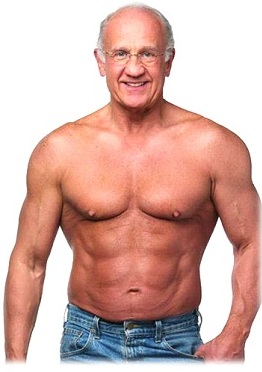
HGH

age 57

age 69

Dr. Jeffery Life.  Advertizes himself all over the internets. Self-prescribes human growth hormone. At his age, this is defensible ... but he should have been doing CrossFit.

Object lesson: the importance of hormones.

FitWorks: hormones made here.

:-)

Here: CrossFitBurbank.com

FW
CrossFit Burbank

Fuel to the Fire

A fit individual can maintain a constant healthy bodyweight for an entire adult lifetime. The body finds its weight according to its activity level, and the diet adjusts itself to that via appetite. If there is less exercise, five extra pounds of useless weight may be gained, from storing more than is used. But it levels off. There is a lag time, then. But there is self-regulation.

Getting fat, very fat, should be no easier than getting very muscular. Both are functions of hormones and metabolism. Eating by itself won't do either. Neither will moving or not moving. There is a range that normal individuals have, within which they will gain or lose weight. After that, it takes exceptional effort or circumstances, or a profound genetic or hormonal disruption.

To get muscular, amino acids and glucose must be directed within muscle cells, guided by hormones. To get fat, free fatty acids and glycogen must be localized within fat cells. It is not the presence of amino acids or FFAs that dictate this. It isn't the presence of insulin per se. It is the receptivity of cells and the prevalence of hormones. A muscle cell takes in raw materials not because they are in the bloodsteam, but because its receptors have been activated or sensitized. Exercising a muscle does that. Then, if sufficient nutrients and the proper hormones, testosterone, HGH, etc, are in the bloodstream, muscle growth will occur. Same deal with fat. An excess of glycerol and insulin, in a generally insulin-resistant body, will result in the pervading corpulence of the current American population.

It isn't about excess calories anymore than being muscular would be. It's about the type of nutrients and the hormonal reactions. Some people are born to be powerful, some to be fat. The rest of us have to work at it, or fall into it by habits of lifestyle. It's not a moral statement. Only choices can be judged by moral standards. We might say, informed choices. That's why there is the Old Testament concept of unwitting sin -- it is treated differently by God. The harm is done, but the guilt is less. Those who are congenitally muscular may be proud, as those who are fat may feel shame or guilt. But not all blessings are earned, nor curses. The universe, like metabolism, is hormonal. There is balance, within a range.

Because muscle is made of protein, and fat is made of, uh, fat, people generally assume there is a cause and effect relationship. But perhaps we've seen the dudes with the protein powders straining away in the gym trying to bulk up those guns. Some of them do. But they usually look, to an informed eye, sort of puffy and soft, and always malproportioned. Unwitting sin. It's the opposite with the fatties. They think fewer calories rather than more grunting will do it. Yes, it will, sort of for a while, until they start eating again in the way they think is normal. But it's not, none of it, about calories, anymore than heat is about fuel. There's a lot of fuel in the world. Why isn't the world on fire?

Some of the work, you just have to do. Sometimes there's no help but what you give yourself. Sometimes there's help.

Here we are.

Be excellent.

Here: CrossFitBurbank.com


FW
CrossFit Burbank

Rewrite

Exercise, in a gym, say, is not about the movements you see there, or the weights being moved. It's about two entirely different things. First, it's about hormones, which we've discussed before. The movement of the weight is just a way of getting a signal sent to the brain, which responds, if the signal is strong enough, by causing the release of some amount of hormones, amount again depending on the magnitude of the signal. Small stress, small signal, small response, small benefit. Like with curls or flies or any other isolation exercise. You're not isolating the muscle. You're doling out the hormones in tiny itsy bitsy little droplets. Use demanding weight, systemically, and an endocrinal demand will be generated. So that's one function of training. Hormones.

The other function of real training has to do with the mind. It's about resetting the subconscious, the autonomic safety gauges that the brain presets to where it thinks the safe place is. But the brain is an old lady crossing guard, looking not just to keep us safe, but to keep us weak and dependent. Now be careful. Don't run. Hold my hand. We never outgrow that, unless we outgrow it. We do so by demonstrating that we can handle new responsibilities. It's like the red zone that the dashboard gauge needle isn't supposed to get near -- but the red starts way too soon. 15 miles per hour. Zoom.

It's by pushing into fatigue that we convince the brain that false signals of fatigue are an unnecessary safety measure. Recalibrate the gauges. Not all, but some fatigue is not real. It's the nagging of the crossing guard, chiding us to go back even when there's no hint of actual danger. Hysterical handwaving in the form of nausea and tunnel vision, and negative self-talk, and phony excuses that nobody else really believes but they don't want to shame us, because then maybe we'll do the same to them. Meantime the brain does whatever it takes to preserve us from the very hint of real stress.

The brain is like a 13 year old girl's body. Her body wants to be pregnant. She doesn't, but it does. It will lie to her, and make her feel all sorts of things, and change the timing of her menstrual cycle, so that it can be pregnant, which is what it wants. Well? Same thing with the brain. Your brain wants you to be safe, and when you're looking to become excellent, safe translates into weak, and slow, and overweight or underweight, and not athletic. Don't blame it. That's its job. Your job is to train it until it learns something better.

It's about emotional unfocus, mental weakness, negative self-talk, eagerness to fail, our ingenuity at finding excuses, our willingness to believe the deals we make so we may strive less -- deals we don't even keep ... I'll run to that tree and then I can walk ... but you start walking even before you get to the tree.

That's the big problem. Call it emotion. The other problem, of hormones, is just biology, and it's mechanistic. Stimulus and response. The properly functioning body doesn't have a choice. It's a dog, that you train. It will obey. The master should be in charge. Like with Confucius, who slapped the father when the child cursed. Generate the signal, and a hormonal discharge is elicited. Flip the switch and the light comes on. If it doesn't, it's not because you didn't flip the switch, it's because something is broken. We're not talking about broken ... well, not broken biology. Broken habits -- or unbroken, rather, left over from babyhood.

Bad habits and weak minds. Weak is okay. We all start out as babies; but babies know how to do only one thing: get stronger. Everything they do is designed to help them survive and grow. The behaviours that are well suited to this specific task under those specific conditions, however, become maladaptive with age and ability. Yet we hold on to them. They are, if you'll allow a serious application of the term, the root of p-factor. The whining and fussing and pretending and self-pity and transparent manipulations. It's infantile.

Who are we trying to fool with all this noise? Ourselves, mostly. Which is sort of sad, but it's universal, this temptation, the same way that the healthy human form follows a predictable pattern. The mind follows patterns as well. The differences between us, those who prevail and those who quit, have to do with how we respond to the voices in our heads.

And that is the point. Which voices to listen to, and more specifically, which voice we deliberately summon up in times of great physical stress. Because ideas matter in more than just our public conduct. They matter in how we motivate ourselves, and in how we fail.

Part of a workout is about generating a deliberately positive, empowering internal monologue, even if it feels like a lie. A monologue of success rather than of discouragement. Because the mind-body connection is clear. The placebo effect is real. Game face is real. And isn't it obvious, that if the lying voices telling us to give up can have an effect, then another voice, that says we can succeed, may not be lying at all? -- even if it feels like a lie? Because we can succeed. At any possible thing. And doing better, running faster, lifting more, working harder -- this is not possible? That's the lying voice again.

It's called rewriting the script. Because the old dialogue sucks, and another unhappy ending is not appropriate for these characters -- us.

Be excellent.

Here: CrossFitBurbank.com

FW
CrossFit Burbank

Live the Difference

Just a little instant info on male/female brain differences. A fascinating subject.

Male brains have a smaller hippocampus, which forms initial memories. Men, per their brains, don't sweat the small stuff. They hardly notice it. Some piece of jewelry, her eye-color ... um, what? It's not personal. An area in the limbic cortex, involved with emotional responses, is also smaller in men, and the region of the temporal lobe that processes language has a smaller density of neurons. So not only do they feel less, but they can't talk about it. Uh, yeah.

The male cortex -- the outer layer of the brain -- is thinner in many places, affecting comprehension and the processing of language cues. Specifically, the dorsolateral prefrontal cortex has almost 25% less volume in men, and there's 13% less volume in the superior temporal cortex. Females seem to devote these thicker cortex areas to noticing and calculating the meaning of clueless behavior in males -- what does it mean, his failure to remember that this is the 15th-week anniversary of when we bought the sofa?!

Females prioritize memories according to emotional strength, relying on the left side of the amygdala, which determines affective responses to events. Men organize memories using the right-brain amygdala, which focuses on the central action and meaning of an event, rather than its finer details. This makes it sound like men might be less emotional. But the ratio between the amygdala and the, ahem, orbitofrontal cortex is much larger in women. The orbitofrontal cortex modulates the emotions the amygdala creates. So women may be more emotional to events, but they control those emotions better, in terms of determinative responses. They are calmer in the face of barroom boorishness.

On the up side, male brains produce over 50% more serotonin, a mood-influencing neurotransmitter, enabling men to deal more calmly with stress -- on average. And the preoptic region of the hypothalmus is larger by all measures in men than women. Twice as large. This is the part of the brain, one of them, that deals with mating behaviour. Yeah! It hooks up -- yeah! -- to the pituitary, which releases sex hormones. Yeah! Go, that long preop hypo word! Yeah!!!

So that's one of the major male/female differences. The brain. Another is the body. Bodybuilding, that sad, sad phenomenon, is doing what it can to blur the differences. Who knows, maybe that's a good thing? Thus, the TLC documentary called Supersize She. Female bodybuilders. Focus, very closely, on a female bodybuilder named ... well, who noticed. Joanna something. A figure not entirely mannish. Yet. Bosoms not completely gone. Steroidal face and voice. Skin like desert leather, beetle-brown body over a creped face pale as disease. Star of a sport identical in spirit to competitive eating. Excess and perversion. It would not exist without Big Pharma.

Then there's the bodybuilder woman from Napoleon Dynamite. The sensi's wife or whatever. Turns out she really was a woman. Who knew. Surprising.

We probably may all pretty much agree that, over all, it's a good thing that there are gender differences. But whether or not it's a good thing, it's a real thing. There are anomalies and overlappings of bell-shaped curves, but generally things fall within certain well-established parameters.

Not health nor fitness is about size. Neither is excellence. Maturity gauges itself by what is reasonable, and understands that there are natural biological limits that really ought not to be overcome by either drugs or fanatical effort. Most men really don't want to look like Arnold -- they want to be strong and skillful. Most women want to be thought lovely and to feel healthy. It's about being physically competent. That's excellence. Freakshows are politically incorrect, nowadays, and rightly so. Except in the gym.

Balance. Common sense. Not wasting time on half-baked theories that, even if they worked, would take you where you don't really want to be. Where should we put our effort? Where it will do some good.

Be excellent.

Here: CrossFitBurbank.com

FW
CrossFit Burbank

T

Part of the trouble with contemporary gym training is that it thinks it's a lot more scientific than it is. It's like a scene from Modern Times, the Chaplin movie, where he's strapped into an automatic feeding machine. The very last word in efficiency, don't you know. All figured out. What could possibly go wrong? Or the 50s idea about how to care for babies in hospitals. Have them all laid out in ranks and files of cribs, with meticulously timed feedings and changings. Exactly 1.32 minutes per hour allotted for cuddling and cooing. Cuz the babies will conform, y'see. We're all cut to a pattern, just an assemblage of organs or a complex but manageable interaction of chemicals.

Uh huh.

As for the gym, the standard model is to have arm day and leg day and ab day and back day and uh shoulder day and er neck day and huh kneebone day that's connected to the hipbone day. How very scientifical. Cuz y'see that way you give duh udder parts uv yer body a chanst tuh rest!

Alas, what's been forgotten in that otherwise very-brilliant-indeed theory is that the actual purpose of being in the gym isn't to move weights around, not to spend a lot of time making painful faces and emitting grunts and other impressive hard-working sounds, not to show off your latest choice in skin-tight gym fashion. All of these things are very beneficial and productive, it must be admitted. But the actual theoretically intended purpose of a gym, with the attendant work presumed, is to stimulate the release of hormones.

You can move as much weight around as is humanly possible, and if there's no hormonal response all you've done is tear muscle down and deplete your biochemicals. On the other hand, if you could generate a tide of hormones, you wouldn't have to do much work at all, and you'd gain lots of muscle. That's what steroids are about. A cheat. We don't cheat, now do we.

So what is it that stimulates the release of hormones? Loud groans and tight shirts? Well, uh, yes, sometimes.  Say no more, say no more.  But in the gym? The thing that tells your brain that it had better send out the signal to get the hormones flowing is engaging major muscle mass during the workout. That is the key. It's all about hormones, and not very much about weight. Except that the thing that provokes the brain, frightens it into reacting powerfully, is the weight.

So you have to move a lot of weight. Otherwise the hormonal signal is proportionally small. So arm day? Well, the biceps are small muscles. Doesn't really matter how much you work them, they are still going to require only a small hormonal response. Add some other body part into the workout and you'll get a little bit more of a response. And if that's what you want, a little response, keep doing arm day. Cuz that's so scientifical and stuff.

Or you could engage the whole body, every workout. Take something like kettlebell swings. Move the weight from knee level to overhead, in a straight-arm arc. Now, what part of the body does that work? The legs? -- back? -- shoulders? Is it an arm day? No, it's body day. Swings work everything, athletically. Major muscle mass is involved, so the signal to the brain is very clear: Need help, send hormones. This is why heavy squats are so productive. Two-thirds of the the body's muscle mass is below the waist. Lots of muscle doing hard work, therefore major hormonal response and significant strength gains. Easy. Why, it's almost like ... like science!

Case in point: deadlift static holds. This is not something to do without proper training. But the protocol is simply to lift a lot of weight at waist level, moving it only about an inch, off a rack. Hands hanging down, holding the bar, and just a little lift at the knees. Hold the weight for a count of ten. Then you're done. How much weight? Well you work up, only once about every week or so, adding weight every workout, 5 or 20 or 40 pounds or 5% or 10% -- doesn't really matter -- it's not a race -- just being safe and consistent. How much weight can you hold?  Grip strength is a limiting factor, but lifting straps or hooks take care of that. You can lift hundreds and hundreds and hundreds of pounds. You don't believe it. But it's true.

Why do this? Because there is a major, massive hormonal signal, that comes from lifting that much weight under those conditions. It's a Gatorade-dump of testosterone. Testosterone and human growth hormone. It's perhaps the single most productive thing you can do. But don't do just one thing. In any case, there's so much more T coursing through your veins that your muscles can't use it all. So there can be a significant increase in libido. Highly significant. Whether or not this is a good thing is a personal consideration. But it happens. The upshot here is that it is direct and undeniable confirmation that there is a significant hormonal response, which is the point of the weightroom and of all those tight sexy gym clothes.

And it validates the theory, that body day works, whereas arm day and glute day is for posers, poseurs, wannabes and steroid users.

But that's not you.

It's not real trendy. It's about results.

Be excellent.

Here: CrossFitBurbank.com

FW
CrossFit Burbank

The Age of Aquarius

The fish have been in the news lately. And the amphibians and the reptiles. How they’re changing their sex all the time. That's so ... alternative. The Potomac is full of such transgendered vertebrates. How daring.

Transmutations of this sort are natural in certain species, as with a type of fish in which the largest female of a group where there is no male will simply become male. Certain lizards can manage the same feat. How interesting. But the Potomac fish are a different kettle of, um, fish. The females are normal. Eighty percent of the smallmouth bass males, however, produce eggs instead of sperm.

At this same time, there is a sharp rise in reported cases on college campuses all along the Potomac of impotence and a lack of sexual interest by males. The Potomac is full of feminizing chemical endocrinal disruptors.

The soft female-like boys of this latest generation, however, cluster not only along the Potomac. We find them everywhere. Throughout the continental USA, in England, in Greenland, in Japan. All over. As for our human females, many of them are enjoying an early puberty, starting around age eight.

Well? Male alligators in Florida are turning up with shriveled testicles and high female-hormone counts. The phenomenon has been linked to phthalates, which are used in clear plastic drinking bottles -- water, Coke, Pepsi and so on. The specific actor is polyethylene terephthalate, PET. When the bottle gets a bit heated, as in a hot car, and the liquid has a plastic taste, that’s PET. All those plastic bottles from Disney World end up in the watershed and affect the alligators. PETs act like female hormones. Girls testing as having high PET levels tend to enter puberty early. Six times higher levels means eight-year-olds with developed breasts.

Elementary school teachers notice the phenomenon. Little boys, and a handful of ten year old girls with fully developed breasts. In olden days the boys were behind the girls by months, rather than years. By thirteen the girls where through puberty and the boys were entering. Now the lag time is three or four years. It’s not just PETs. It’s a lot of chemicals. Endosulfan, for example -- a major commercial pesticide -- was shown in 2003 to disrupt the onset of puberty in boys, by blocking the effects of testosterone and other androgens.

The actions of these industrial chemicals are overwhelmingly feminizing, hastening puberty in girls, delaying and distorting masculine development in boys. Seems like a problem. The plastic in baby bottles, for example, has been shown actually to damage male neonate animal brains, specifically in memory and motivation functions focused in the nucleus accumbens. The same damage does not occur in females. The males demonstrate less curiosity about their environments, and their activity profile strongly resembles that of control females. Strangely, females exposed to the same plastic demonstrate heightened activity, environmental curiosity, and learning ability. Again, the only relevant variable here is the plastic.

Increased ADHD in boys. Decreased testosterone and semen levels than in previous generations, lower sperm count, and endemic infertility. Genital malformations are up by three times; pregnant mothers who drink phthalates are ten times more likely to have boys with undescended testicles, or subaverage penis-size, or hypospadias (misplaced urethra terminus).

From these specifics we might derive any number of insights, environmental, political, sociological, ethnographic. We won’t bother to flesh it out. We could talk about planting the seeds of our own destruction, for all that there are fewer and fewer seeds. Why bother. Everyone talks about history, but nobody does anything about it. Is there a solution? Well, first, is there a problem? Maybe it’s a good thing? We become extinct and save the planet from our pollution and global warming? We remove our unclean presence and leave the world to the purity of the encroaching desert? What after all has freedom and free will given us? Melting icecaps and mutant fish. Yin yields to yang.

On the other hand, we might choose not to use clear plastics to drink from. We might wash our vegetables (alas, animal flesh stores such chemicals at an even higher density). It starts with being aware of the problem. After that one can choose to care, or not. If biologically generated motivation from out of a healthy nucleus accumbens is insufficient to make us care, perhaps ethics and a commitment to some intellectual ideal might do it. How are we to know what will move us to responsible action? Sociological movements are not planned.

But that’s why we should eat healthfully. Health matters for so many reasons.

Does the title here, "The Age of Aquarius," seem impenetrable to you? We did not know what the New Age would bring. The triumph of hippie values is brought about by the very thing they rebelled against. Corporate chemicals -- as opposed to hallucinogenic ones. Their feminine-leaning ethos triumphs against its masculine counterpart at the cost of infertility. The New Age is bringing not love, love, love, but sterility, deformity and extinction. What is the point of saving the planet, if we fail to save the human baby boys?

Grand theories about saving the planet are all very fine and good. How laudable it is, to be so ethereally idealistic. Yes, smoking should be banned. Just like alcohol should be banned. Oh. Wait. Um, well, let's rethink this. Smoking should be banned in our own lives. We ourselves should take responsibility for us ourselves. Before we take responsibility for anyone else, we should take responsibility for ourselves. Yes, that sounds more sensible.

We'll start with our own bodies, our own health, the composition of our own flesh, its ratio of muscle to fat. That way we won't be metaphysical theoreticians, like Marxists making predictions about how capitalism will fade away into a worker's paradise -- we'll have some credibility. Our own house will be in order. We'll start by having a sensible diet, engaging in sensible exercise, excluding the obvious poisons from our lives, and as they become apparent, the more subtle ones. That way we won't be loudmouth hypocrites or soapbox saviors. We'll be effective realists, admirable examples who make a difference by the excellence of our own lives.

Preachy? Yes. Not soapbox though. Realistic. It's about personal excellence. Everything else is theories about politics. How boring.

Be excellent.

Here: CrossFitBurbank.com

FW

Letting Off Some Steam

Counterintuitive ain't the half of it. We seem to have gotten our understanding of obesity and weightloss from infomercials. Can that be possible? What about Oprah? -- didn't she lose a bunch of fat? And Robert De Niro -- he got fat on purpose for Raging Bull. So eating more will make you fat, and diet and exercise can lean you down. It's obvious. But controlled studies consistently invalidate this observation. Calorie restriction for the obese results in lower basal metabolism and decreased energy expenditure. Exercise increases appetite and for the effort provides a relatively insignificant energy expenditure. That's the clear conclusion from the studies.

It's not genetic, as we know from the obesity epidemic. If Americans were generally not fat 30 years ago, and three times as many are fat now, it's environmental, some behavioral change of diet, lifestyle, etc. It's genes responding, not demanding. So why is it happening? That's not the question right now. Now, it's why isn't it changing, with diet and exercise.

It's as if somewhere in the brain there is a silhouette of what it thinks we should look like, and the brain works to maintain that shape. That's not how it is, but as if. There is a gradual increase and excess of calories, however, that allows for the slow modification, adaptation of that image, so that slow fat gain can be sustained, whereas sudden change is more easily reversed. It's really a function of insulin -- but insulin is subject to homeostasis, even if an unhealthy one.

Undoubtedly meditation, visualization, affirmations can hack in as it were and edit that image, allowing for successful weight loss where a merely thermodynamic approach will fail. We can say will fail, because that's what the mechanistic studies show -- treating fat loss as a mere equation of positive or negative energy balance results in failure. The homeostatic silhouette gauge makes adjustments -- faster heartrate, more spontaneous movement, nervous energy, body temperature fluctuation, manipulation of appetite and cravings -- anything to waste or conserve energy, calories, fat. We know the mind-body relationship is controlled but not ordained by hormones -- the way a puppet is controlled by stings ... it goes beyond the strings. Point is, thinking matters.

The diet and exercise paradigm, to which every sensible person must be attracted, seems to be wrong. You'll have to look at your own life experience to see if it has worked. It's not a simple equation, energy in, energy out. If the body were a closed system, that idea would work. But it's not a closed system. There's leakage. It's not energy in, which is either stored or burned for purposeful metabolic functions. Such functions can be quantified, as body heat or lifting or locomotion or breathing or heartbeat or shivering. These are purposeful, and because of that they are predictable, quantifiable, and variables of an equation. The silhouette gauge is a randomizer, in that insulin may be set too high -- making you too fat. Why? Who knows. Aside from too many industrial carbs that is.

Think of the body as a steam engine, in an old fashioned train. A heap of coal, a furnace, and a way to get work done. Easy. Straightforward math, whatever the details. But then there's the whistle. The safety valves, that keep the boiler from exploding. It confounds things. Some people are always blowing their whistle. A lot of wasted steam. Keeps them lean. Some people let the pressure build until it's dangerous. Not on purpose -- it's just how the thing is built. Some engine cabs just keep filling up with coal, that doesn't get burned -- or the firebox has a problem, and the coal builds up there. You get the idea. Not an elegant analogy, but you can play with it yourself.

The point is that the calculations can't be valid if the system is not closed. How can people eat less and still be fat? First, metabolism is not even a steam engine, but rather a hybrid motor, that uses different fuels in a pattern we haven't recognized yet. Then, well, the system is not closed. What goes in? Calories? How meaningful is that? Something burned in a crucible is supposed to translate one-to-one into metabolism? Isn't that actually sort of an insane assumption? And once we have digested these "calories", they can be used only according to the mechanistic expectations of thermodynamics? We're all for thermodynamics. For mechanistic systems. The fact that fat people can eat less and exercise more than lean people confounds the issue, though, wouldn't you agree?

There's an engineer at the switch, and he operates according to rules that you don't find in elementary physics textbooks. He decides wheel speed and burn rates and heat and pressure and noise. He doesn't like to be starved, and he works at his own pace. How do you make him happy? Feed him right, and have a conversation.

That's all. That's all for now. Complex, and simple. Diet and exercise. We eat right for health. We exercise for fitness. Both matter, a lot. Food makes our bodies, and we use our bodies to do the things that life is about. Energy and movement. Diet and exercise. That's it.

Be excellent.

Here: CrossFitBurbank.com

FW
CrossFit Burbank

How Things Work

It just seems so interesting, how the brain works, or the mind-body connection, or the CNS-PNS. However you'd describe it. It's just fascinating. Afferent and efferent nerves. Same as sensory and motor nerves. Only two sorts of neurons, inward and outward, to the brain or away. Inward is sensory, information about everything other than the brain, whether within the body or from the great wide world. Outward is motor, to get things done, either muscles or organs, somatic or autonomic. Neuron axons bundled in the peripheral nervous system are nerves; axon bundles in the CNS are called tracts. Isn't it fascinating?

The brain communicates with the body in only two ways: through motor nerves or through hormones. Nerves are a direct line, like telegraph wires. Hormones float through the bloodstream hoping to be picked up by cell receptors -- like fish and nets, without the hope. Isn't that interesting? In order to explain things, you need facts. Why does exercise make muscles grow? An exercised fiber becomes more receptive to hormones. Hormones are released when enough fibers are exercised. So it's central nervous system, and it's endocrinal. Obvious of course, but so interesting.

It's easy to gush -- it's so interesting.

And the way the CNS develops -- the brain and spinal cord. It starts as a sort of looped tube, eventually with, well, six parts, spinal cord and the five parts of the brain. A tube. See? It's not an addition thing, this development, not one part of the brain developing, then another one, more advanced, then yet another, and so on. New parts of the tube just appearing one day, or epoch. It's all there, inherent in the beginning. See? It's not an Evolutionary development. It all happens more or less all at once, with all vertebrates, the way you'd blow up a plastic bag. There is no fish brain and lizard brain and mammal brain. There are just bigger and smaller parts of the brain, depending on class. A fish's cerebrum is smaller than its eyeball. A rat's cerebrum is the size of its ear. Humans' fill up everything behind the eyes and up. But it's all the same basic plastic bag -- just different shapes.

That's the body, and the brain. Not quite the same as mind, or as some would have it, the soul. Think of it as music. Flute music. What makes it? The breath of the player? The shape of the instrument? Neither, alone. Both, but not only both. Music is not breath and flute -- that might very well be just noise. We are made by genetics and shaped by experience -- but we are not just both of these, together. We are not breath through a flute, not experience acting through genes. We are music. There is a musician, a spirit if you will, inspiring as well as respiring.

Well. It's about being excellent. Utilizing our gifts. We can't save anyone. We can help each other, though, help a human, with a body, achieve a level of physical excellence.  You do it, if you will. We help.

Be excellent.

Here: CrossFitBurbank.com


FW
CrossFit Burbank

Unforgiven

Deserves got nothing to do with it.

Has to do with justice. An illusive thing. Hybrid of the unicorn and the snipe. Or is that just cynical. Point is, we deserve what we earn. We earn what we work at -- where we put our effort and time. If you spend a lot of time, oh, say, eating, then you most certainly do deserve those extra pounds.

An unsympathetic judgment? Reality is ever so unforgiving. Gravity doesn't call a timeout. You stumble, you fall -- or catch yourself; in neither case does gravity bend its rules.

We deserve what we earn, whether or not we get it. Wanting fitness, or an attractiveness of figure or physique -- well, that's just an emotion, the wanting. Do you deserve what you want? Only if you've earned it. We exclude of course such basic human rights as air and justice. We deserve justice, although we may not want it. Depends what our conduct has been, eh?

So when advertisers tickle our ears by suggesting we deserve every wonderful thing, yeah, there's the part of us that says, "Yep, that's right -- I deserve it! Cuz I'm so great! Yeeeah!" Then there's the rational part of the brain, that remembers cause and effect.

You rewarded yourself with that half-gallon in one sitting of rocky road ice cream because you earned it by having a hard day at work, or by having your paramour disrespect you so that you required some other comforting. That was the intent of eating all that ice cream. And you were comforted. But those 2700 calories amount to almost one sexy pound of body fat. You earned that too, by eating the ice cream -- and hoping that your body uses it to give you Angelina Jolie lips may not be a desire thoroughly grounded in reality.

We deserve what we earn. Physics is not forgiving. Entropy is the presiding law of the universe. Miracles come from outside of the universe, and, like forgiveness, have to do with grace, with unmerited favor. We hope for it, but we don't deserve it. Hardly ever.

A dark message? But no! -- a message of hope. Because when we apply intelligence to any mechanistic system, entropy is reversed. Order increases rather than declines. Beauty is generated. We grow fit. We become, in a very real way, younger. Why, it's almost miraculous! Strange, how going through some ritual can change reality. Working out, then -- that most mundane of processes -- is where magic comes from.

You deserve what you earn. You earn what you work for. They call it "working" out for a reason. Of course we all know this. But if that's the case, why do the advertisers try to tell us otherwise? You deserve a break today? Maybe. How would they know? Indeed, they know as well as we do, that people only deserve what they earn. And if they know it, why are they lying? -- and if they're not lying, how did they get so crazy? Bewildering.

How to earn what you want? In this context, effective exercise, and responsible diet. It's not about tickling your ears, unless its from beads of sweat running down the side of your head.

Be excellent.

Here: CrossFitBurbank.com


FW
CrossFit Burbank

Getting Serious

Being sedentary is certainly not the same as sloth. Working at the computer is work, and productive. Not a deadly sin at all. A virtue, even. Not sloth -- sedentary. But the body doesn’t know the difference. Bodies don’t get it, about morality and wickedness. They just feel and react, like animals. The thing that distinguishes our bodies from those of animals is our magnificent brains, what with their intellects and wills and, uh, other good human stuff. Ambition. The ambition to excel.

We say it a lot, because simple truths resonate the loudest: As easy as it was to get out of shape, that’s how hard it is to get back into shape. On the other hand, getting back into shape is like forgiveness. It’s like redemption. It’s almost religious. Hallelujah. The cliché is, the more you put in, the more you get out. True, but that’s a sort of euphemistic way of saying it. The harsher, more accurate way to say it is that it takes intensity. That’s harsh because intensity really means suffering. Breathing a little hard is not intense at all. Gasping like you’re terrified is intense.

That’s the bad news. The good news is that most folks don’t aspire to be world class, elite athletes, so they don’t need to suffer quite that much. Their intensity level can be much lower, and they can still attain very respectable goals. The other bad news though is that their intensity must be much, much, very much more than just breathing a little hard.

It really isn’t about the effort. It’s not about desire or will power. It’s about your body’s hormonal response, the signals to and from your brain that tell the body to store or burn fat, or build muscle, or the like. Wanting such messages to be sent isn’t enough. Sending a clear signal is what it’s about. We send those messages by stressing the body. The bigger the stress -- not, mind you, distress -- the clearer the signal, and the more beneficial the response. In this case, intensity equals effectiveness.

Effectiveness matters, because most people are not genetically gifted. The dudes you see on the muscleman mag covers, they didn’t get that way because they had effective workouts. Barring steroids, they’d look like that by doing pretty much any workout. They have bodies that respond to motion, whereas most of us have to do actual exercise -- the effective kind, that we’ve talked about before.

So, depending on your genes to keep you healthy and looking good is a bad plan. It’s like depending on luck. It’s not a plan at all. It’s depending on your body, your animal body, rather than your magnificent human brain. Your body is what got you out of shape. Your brain will get you back into shape -- by disciplining the beast, the way a lion tamer works his craft. Crack the whip.

If people could do it on their own, there would be no fitness specialists. On the other hand, if people could set their own broken bones or treat their diabetes, there would be no doctors. Point is, we need help. Help with what’s effective, rather than what’s a waste of effort, and help with motivation -- it’s all so emotional, after all. It’s on you, you know, your health and appearance and the way you feel. But feel free to ask for help.

Be excellent.

Here: CrossFitBurbank.com


FW
CrossFit Burbank

How Muscles Work

One of life's real fascinations, the human body and its functioning. How we think, how we move, how we feel -- and why. Fascinating. Sometimes we  read textbooks just for the fun of it.  Is that strange?

Skeletal muscles, then. The ones we have control over. Some, we don't. Arteries, for example, are wrapped in muscle. Aside from caked on, um, sewage, that's how they tighten up, so we can enjoy high blood pressure. We control arteries only to the degree that we control our emotions. Hardly at all.

Let's get a little technical. There are those big clumps of muscle, say, your calf. Like a bundle of cable, wrapped up in a connective tissue called the epimysium, which fades, transitions, into tendon, the function of which is just to tie muscle to bone ... Achilles tendon. The epi-casing is filled with cords that are wrapped, caulked, in perimysium. And inside these cords are actual muscle-cells bundles, wrapped in endomysium. See? Epi is ON the muscle, peri is ABOUT the muscle, and endo is IN the muscle. Three kinds of connective tissue, on a descending scale: epi, peri and endo.


So that's one sort of organization. The big (epimysium-covered) muscle bundle holds some number of (endomysium-covered) cords, each called a fasciculus. Fasciniculating, isn't it. And the fasciculus is full of muscle fibers, the actual cells, that do the work. Cords have threads, fasciculi have fibers. At last, we're there.

Muscle fibers, cells, don't multiply. So it is generally thought.  We don't get more of them, when we do the Arnold thing. Instead, inside each fiber are some number of myofibrils. That's not hard to remember, is it? Fibers have myofibrils. Sometimes thousands. Depends. Did you exercise? Then you'll have more myofibriLs. This is where the change occurs. Myofibils are just long strings of proteins, which do the actual work, the contracting, moving, the heavy lifting.

This is where it gets really interesting. All this other stuff is just the alphabet. How do muscles actually move? Well, first, a muscle only contracts. It only pulls. That's its function. The biceps, arm muscle, pulls the wrist to the shoulder. You'd be stuck there forever, or just flop around, except that you have an opposing muscle on the back of the arm, an antagonist that pulls the wrist back, straightens out the arm. Triceps works in cooperative opposition to biceps. Easy. It's like that with all the skeletal muscles. There is no pushing. There's only pulling in a different direction.

But how does it happen, this pulling, this contracting? Observe.

Helpful?  Here's how it works (we think). The red part in the illustration, inside, represents filaments of myosin, a protein. Think of the little balloons as waving around like random seaweed. When a spark is sent from a nerve, across the synaptic gap into a muscle receptor, it causes the muscle cell to release calcium ions out of storage and into the cell fluid, sarcoplasm. Calcium acts as a key, which fits into a protein lock (troponin), which opens a protein door (tropomyosin) located all over the blue strands, outside in the illustration. The red is myosin, the blue is actin. My Act. So the doors are open on the actin: Action!

Those floating myosin balloons plug into the actin holes, and pull, right-side pulling left, left-side pulling right, toward the center. How do they pull? Electricity. You know, magnetism. Attraction and repulsion. Positive and negative poles. That's what ions are all about -- unbalanced electricity trying to get balanced. We're magnet operated, like something magical invented by Tesla.

Now it's a sort of bucket brigade tug-of-war, where two actin tubes slide along a myosin rod, toward the middle. The rods are free-floating, independent, contained as it were in the tubes. The tubes of actin however are hooked up end to end, all the way to the end of the cell, which is hooked up to the connective tissue, which is connected to the bone.

Once a myosin head, the balloon, has made its one wave, its pull, it unplugs from the actin, which has slid a tiny bit toward the center. Now that same head plugs into another receptor a tiny bit closer to the end. They do it out of sync, so it's not a one-two-three-heave sort of affair. Smooth.

There's more to it, of course. Like with sodium and its counterpart potassium. Together they generate an electrical impulse in a nerve cell that ends as the on-switch for muscle twitch. But all that's slightly outside our scope. It could go on forever.

Knowing this, we might ask -- in love as we are with excellence and superb physical performance -- how we can facilitate the process, at this ionic level. Can myofibrils learn? -- improve? Well, all they do is a sort of zipper slide. It must be about available energy, damage repair and maintenance. That's nutrition. The more calories you eat, the more free-radicals -- stray bullets -- are ricocheting around your DNA, doing damage. Like racing an engine in the red zone -- lots of pollution. So eat the minimum necessary. Then, providing nutrients -- that most minor of reasons to eat, way less important than tasty pleasure, or calories for energy. Or so it seems, for so many folks. All that calcium and potassium and, yes, even sodium -- you couldn't move without them. So have what is necessary.

That's diet. Exercise? Well, training makes you more fit. But how about at a cellular level? Can you train myofibrils? It seems that if you use a maximum contraction, have as many myosin heads engage as possible, plug all the actin receptors there are -- pull the zipper as far as it will go -- if you do that, there must be some training benefit. Some feedback mechanism that encourages and facilitates the process? Static holds of maximal weight send a terrifically powerful signal to the brain, but that's at the hormone end of the formula. Would using a maximal contraction have an analogous effect on the muscle fiber side of the equation? Tests of the theory suggest so.  Ah well.  We could go on.  It's all so fascinating.

So that's how muscles work. But of course the real reason they work is that you decide to exercise, rather than sitting around watching soap operas and gaining a pound of fat each year until you die. That's the pattern. How sad. But we're better than that, or will be. We can't control everything, but we can control what we do. Sometimes we need a little help.  With exercise, with diet, and with the really hard thing, motivation.  So?  Get help, if you need it.  Because natural selection isn't impressed with civilization, and excuses don't work with the coroner. 

Be excellent.

Here: CrossFitBurbank.com


FW
CrossFit Burbank
For more, click "Older Posts"

Contents copyright © FitWorks, Inc